
Mhatma Ghandi, fondly known as the father of the Nation was one of the greatest leaders in world history.His life and teaching continue to inspire people across the globe Gandhi devoted his entire life to truth, non-violence,and the service of humanity.Throuh his principles and actions, he led India to freedom and set an example for generations to come.
Early Life and Education
Matatma Gandi was born on 2nd October 1869 in Porbandar, a coastal town in Gujrat.
India. His father, Karamchand Gandhi, served as the Diwan (chief minister) of Porbandar, and his mother, Putlibai, was a deeply religious and kind-hearted woman. From his mother, Gandhi learned the values of honesty, self-discipline, and devotion to truth.
After completing his early education in Porbandar and Rajkot, Gandhi went to London in 1888 to study law at the Inner Temple. He successfully became a barrister in 1891 and returned to India to start his legal career. However, he found little success as a lawyer and soon accepted an opportunity to work in South Africa in 1893.
Struggles in South Africa
In South Africa, Gandhi faced racial discrimination and injustice. Once, he was thrown out of a train for refusing to leave the first-class compartment reserved for white passengers, despite holding a valid ticket. This incident marked a turning point in his life. He decided to fight against racial injustice and inequality, not through violence, but through peaceful resistance.
During his 21 years in South Africa, Gandhi organized the Indian community and led several campaigns against racial laws. It was here that he developed his famous philosophy of Satyagraha, meaning “holding firmly to truth.” Satyagraha emphasized non-violent protest as a means to achieve justice and social change.
Return to India and the Freedom Struggle
Gandhi returned to India in 1915 and soon became a prominent leader in the Indian National Congress. He observed the suffering of Indian peasants and workers under British rule and decided to dedicate his life to India’s independence.
He first led the Champaran Satyagraha in 1917 to support indigo farmers oppressed by British planters in Bihar. His success there made him a national hero. Later, he launched other major movements such as the Kheda Satyagraha, Non-Cooperation Movement (1920–22), Civil Disobedience Movement (1930–34), and the Quit India Movement (1942).
In each of these movements, Gandhi urged people to fight peacefully, to boycott British goods, and to promote self-reliance through swadeshi (using Indian-made products) and khadi (hand-spun cloth). He believed that India could only be truly free when its people were self-sufficient, disciplined, and united.
Philosophy and Principles
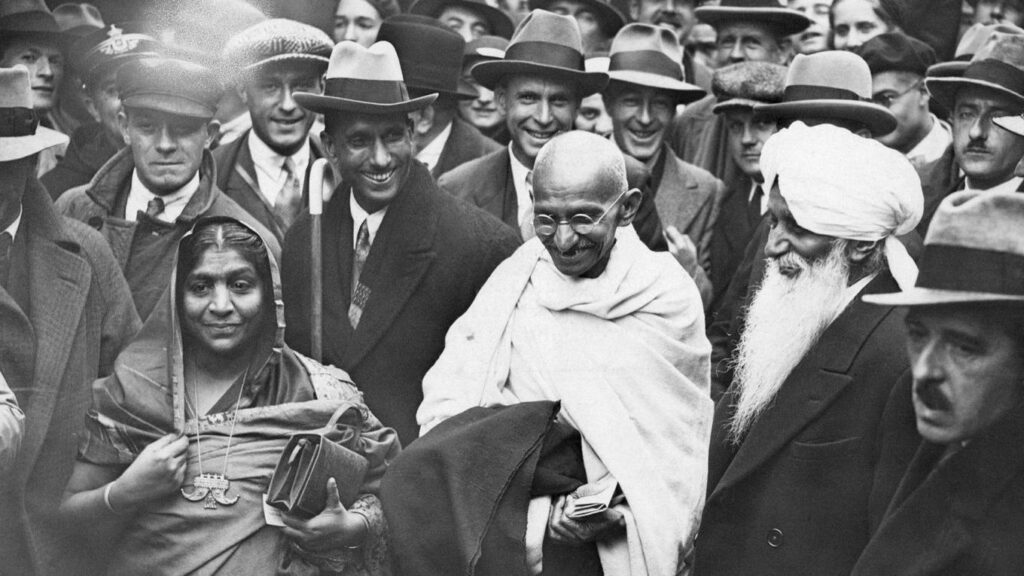
Gandhi’s entire philosophy was based on truth (Satya) and non-violence (Ahimsa). He firmly believed that one could achieve lasting results only through moral strength, not through hatred or bloodshed. He lived a life of simplicity, wearing only a khadi dhoti and shawl, spinning his own yarn, and eating simple vegetarian food.
He also fought against social evils like untouchability and promoted equality for all, regardless of caste, creed, or religion. Gandhi emphasized the importance of education, cleanliness, and rural development. His vision of India was one where everyone lived with dignity, harmony, and self-respect.
Death and Legacy
Sadly, on 30th January 1948, Mahatma Gandhi was assassinated in New Delhi by Nathuram Godse. His death was a great tragedy, not just for India, but for the entire world. Yet, his ideals did not die with him. Gandhi’s philosophy inspired many global leaders and movements, including Martin Luther King Jr. in America and Nelson Mandela in South Africa.
Even today, his birthday, 2nd October, is celebrated as Gandhi Jayanti in India and as the International Day of Non-Violence around the world.
Conclusion
Mahatma Gandhi’s life was a shining example of truth, courage, and compassion. He proved that great changes can be achieved without violence. His teachings remind us that peace, love, and tolerance are the strongest weapons against injustice and hatred. Gandhi will always remain a guiding light for humanity—a man who taught the world that one can “be the change you wish to see.”